
High ground above the border routes
Chard stands on the A30 in Somerset, south-west of Yeovil and close to both the Devon and Dorset borders. At 121 metres it is one of Somerset’s highest towns. That elevated setting is a reason to examine ridge and verge fixings after wind, not proof that every roof suffers the same exposure. The property’s orientation and surrounding shelter still matter.
Our Taunton base covers the town and surrounding villages within the stated approximate 50-mile area. Homes, shops, rentals and commercial buildings can all be discussed. Give the full address and identify which slope or lower roof is affected rather than treating a postcode district as a roof description.
Fore Street, Holyrood Street and the stone centre
Chard’s historic centre was largely rebuilt after the 1577 fire and includes local stone buildings. The Guildhall, the 1834 corn exchange, is Grade II* listed, while the parish church is Grade I. Chard’s conservation area and nearby Wadeford require address-specific checks; not every building has the same restrictions. Somerset Council, not the former South Somerset District Council, is the planning authority.
When changing a visible roof detail, establish listed status and consent requirements before ordering materials. A like-for-like appearance does not remove the need to consider tile or slate dimensions, fixing suitability, lead junctions and compatible mortar. The Victorian lace-factory buildings associated with Bowden’s and Gifford Fox provide a separate commercial context, where larger roof layouts and access may affect the scope.
Roof repairs in Chard
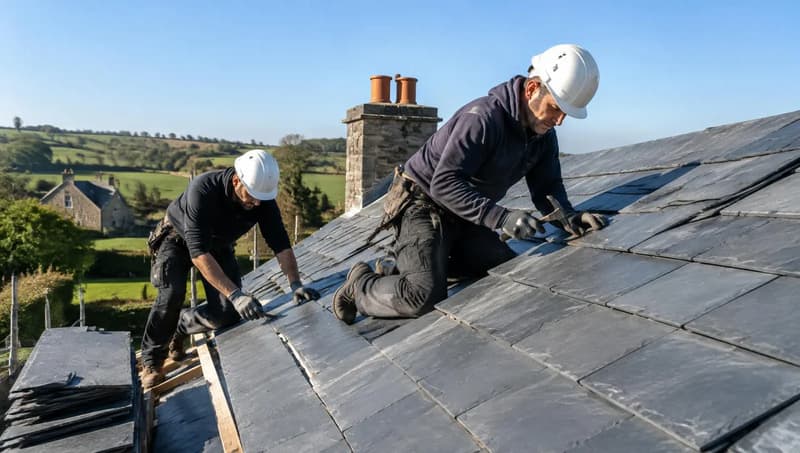
A roof repair enquiry in Chard might concern a single cracked tile letting rain through, a run of slates that have slipped because their nails have rusted away, or a ridge where the old mortar has crumbled and the tiles are rocking in the wind.
With tiled roofs, we replace broken or displaced tiles to match as closely as possible, and rebed or repoint ridges and verges. With slate, each slipped or broken slate is refitted, usually using a discreet fixing that holds it in place without stripping the area around it. Valleys, where two slopes meet, are another frequent source of trouble, because they carry a lot of water and collect leaves and moss.
Our roof repairs page sets out the full range of what we fix. If you've got a drip coming through right now, have a look at our guidance on what to do when your roof is leaking.
If the roof is leaking now
Tell us when you call that water is coming in, and describe roughly where you see it. We offer emergency leak call-outs. The approach is made safe fast, then put right: a temporary measure to stop more water getting in, followed by a proper repair once the cause is clear and the weather allows.
In the meantime, catch drips in a bucket, move anything valuable out of the way and keep clear of any wet light fittings. Please don't go up a ladder onto the roof yourself.
Chimney work and leadwork
At an older property, a brick or stone stack needs its own condition check. Washed-out joints, cracked flaunching and loose pots let water into the stack, and that damp can show up on a chimney breast inside. We repair and repoint stacks, covered on our chimney repair page.
Where the roof meets the chimney or a neighbouring wall, the joint is sealed with lead. If that has lifted or cracked, we renew it. Our lead roofing page has more on flashings and valleys.
Flat roofs and re-roofs
For extensions, garages and dormers, we fit new flat roofs in EPDM, GRP or felt. And where a pitched roof has had enough, we offer a complete strip and re-roof with new membrane, battens, tiles or slates and leadwork.
Small faults, caught early
A single slipped slate or a hairline crack in the ridge mortar rarely looks urgent from the garden. Left through a wet winter, though, it can let enough water in to stain a ceiling or soften a batten. If you've noticed something that doesn't look quite right, it's usually cheaper to have it seen to now than later.
Emergency roofing repairs Chard: report the immediate risk
For emergency roofing repairs in Chard, say whether water is entering an occupied room, a ceiling looks unstable or material is loose above an entrance. These are different hazards, and the enquiry should identify each one. The emergency roof repairs page explains the service without establishing a guaranteed arrival time.
On the town’s higher ground, report displaced ridges or verges as well as the indoor leak. Photographs taken safely from the ground can show the affected run without putting you beneath unstable materials. Access, weather and the identified defect govern what can be done safely.
Roof cleaning Chard: avoid confusing moss with damage
Roof cleaning in Chard should begin with the covering’s condition and a clear purpose for the work. Moss can obstruct drainage, but its presence does not prove that a roof is at the end of its life. Conversely, clearing growth will not mend a fractured slate, an open flashing joint or a weakened batten.
Read the roof moss removal and cleaning guidance and ask how the chosen method will suit the material. Fragile surfaces need care, with debris managed so it does not block gutters. Guttering and roofline work may be a separate item. Survey-led spray foam removal enquiries should likewise remain distinct from cosmetic cleaning or routine roof repairs.
Booking a visit
Ring 07399 680142 on weekdays from 8am to 5:30pm or Saturdays from 8am to 3pm, or send us a message through the contact page. Jason will come out, look at the roof and send a free written quote. Closer to Taunton, see Wellington. Over the border in Devon? We also cover Honiton, and the rest of our patch is on the areas page.
Villages around Chard
We cover up to about 50 miles from Taunton, which takes in the villages around Chard and over towards the Devon and Dorset borders.
Rural flues and chimney repair options
Across Somerset, 11.8% of households reported oil-only central heating in Census 2021. This is a county-wide figure, not Chard’s own heating mix. If the property has a working flue, identify it in the enquiry. Repointing, flaunching, pots, capping, flashings and rebuilds are considered after looking at the stack and discussing whether it needs a repair or more.