
Signs your chimney needs attention
Chimneys take more weather than any other part of a house. They stick up above the roof line, catch the wind from every direction and get soaked from all four sides. Most of the time nobody looks at them until something goes wrong indoors. Keep an eye out for:
- Damp on the chimney breast — stains, bubbling paint or peeling wallpaper, often worse after heavy rain.
- Loose or missing mortar — gaps between bricks, or bits of mortar turning up in the gutter or on the drive.
- Lifted flashing — lead around the base of the stack that has pulled away, split or been patched with sealant.
- A leaning stack or cracked render on the chimney.
- Damp in the loft around where the chimney passes through.
Any of these is worth getting checked. Water that gets into a chimney can travel a long way down through the brickwork before you notice it.
Repointing the stack
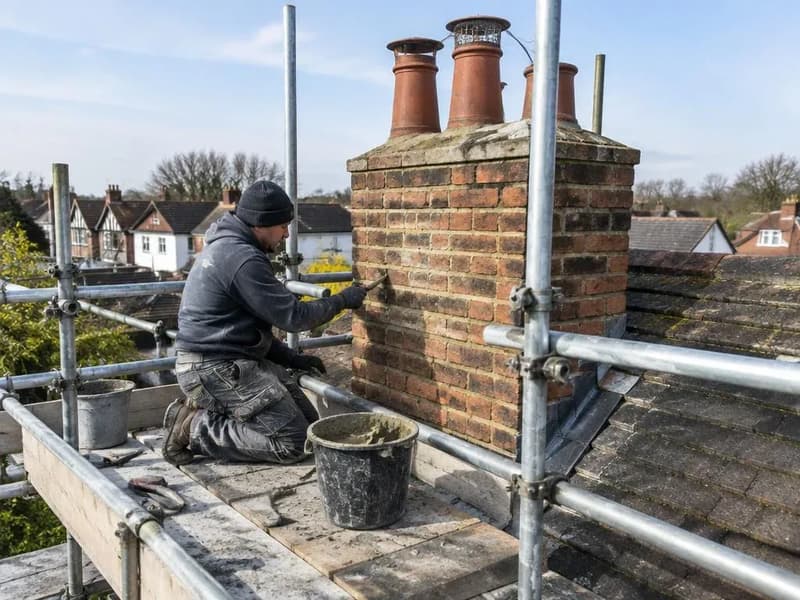
Mortar is meant to be the weak point — it's softer than the brick so it wears first and can be replaced. Over the years, frost and rain break it down until the joints are open and water can soak straight in.
Repointing means raking out the old, failed mortar to a sensible depth and packing the joints with fresh mortar mixed to suit the bricks. On older properties that often means a softer, lime-based mix rather than hard modern cement, which can trap moisture and damage old brickwork. Getting the right mix for your property matters as much as the work itself.
Lead flashing around the chimney
Where the chimney meets the roof there's a joint that has to stay watertight while the roof and stack move slightly with the seasons. That's the job of the flashing — lead dressed against the brickwork and over the tiles. When it lifts, splits or comes loose from the mortar joint, rain runs straight behind it.
As part of a chimney repair we check the flashing, refix or reseal it where it's sound, and replace it where it isn't. A quick blob of sealant might stop a drip for a few months, but it's no substitute for properly dressed lead.
Chimney work during a re-roof
If you're planning a new roof, it's the ideal moment to deal with the chimney. The scaffold is already up, the old flashing comes off anyway, and the new lead ties in with the new tiles or slates. Doing both at once avoids paying for access twice. Our re-roofs and pitched roofs page explains how a full re-roof runs.
If the rest of your roof is in good shape and only a few tiles around the stack have been disturbed, those can be dealt with under our general roof repairs. For more on flashings, valleys and abutments, read about our lead flashing and leadwork.
Access and safety
Chimney work happens at the highest, most exposed point of the house, so safe access comes first. In most cases that means scaffolding around or up to the stack. We arrange it where needed and include it in the price so there are no surprises. On some low bungalow chimneys other access may be possible — we'll tell you at the visit.
Chimneys no longer in use
Plenty of houses have stacks that haven't seen a fire in years. They still need looking after, because rain doesn't care whether the flue is used. A cap or cowl can keep water out of an unused pot while still letting the flue ventilate. We'll explain the options when we visit.
Free written quote
We repair chimneys on domestic and commercial buildings across Somerset and Devon, within about 50 miles of Taunton. Ring 07399 680142 or get in touch online for a free written quote. A photo of the stack from the ground is a great help when you first contact us.