
How a slate roof is put together
Each slate is nailed to timber battens and overlaps the two courses below it, so rain always runs over a slate rather than into a gap. Slate is heavy, and its shape doesn't give it a lip to hook over a batten like many tiles have, so it relies completely on its fixings. That is why slate roofs fail in particular ways, and why slate roofing work needs a different approach from a concrete tile roof.
Common slate roof faults
- Nail sickness: old iron nails rust through and slates start sliding, often several in the same area.
- Cracked or delaminating slates: lower-quality slate can flake in layers after years of frost.
- Ridge and hip problems: mortar bedding fails and ridge tiles loosen.
- Worn lead at chimneys, valleys and abutments, which is often the real cause of a leak blamed on the slates.
- Rotten battens on roofs with no underlay, where damp has had access for decades.
Slate roof repair
Individual slates are replaced by cutting the old fixings, fitting a matching slate and securing it with a clip. Matching matters: a slate of the wrong size, thickness or colour sticks out and may not lap properly. Where a cluster of slates has slipped through nail sickness, it's often better to strip that section, renew the battens and re-lay the sound slates with new nails. Ridges are rebedded or fixed mechanically, and any lead that has cracked or lifted is renewed. Our wider roof repair page covers tile roofs too.
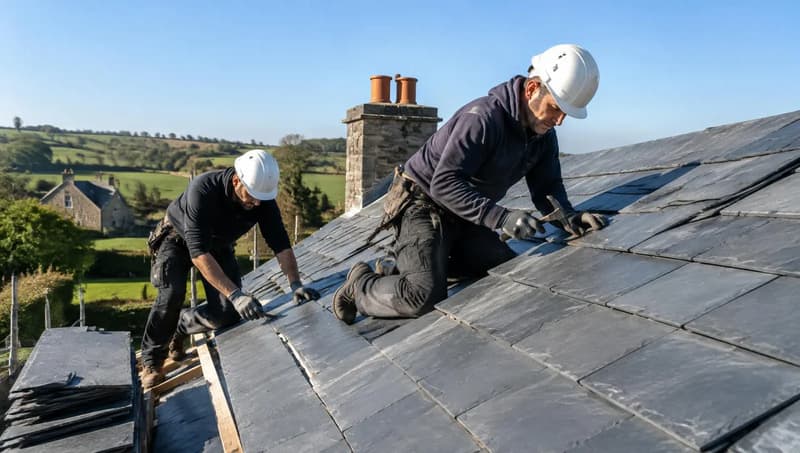
Slates on older houses
Many older houses have slate roofs laid without any underlay, so the only thing keeping rain out is the slate itself and the way the courses overlap. When slates slip on those roofs, water lands straight on the battens and ceiling joists. Some were also torched from inside, with lime mortar pressed under the slates to stop wind lifting them. That torching crumbles with age and drops into the loft as dust. Neither is necessarily a reason to replace the roof, but they change how repairs are done and are worth knowing about.
Slate roof replacement
If nail sickness is widespread, slates are failing across every slope, or the battens are rotten throughout, piecemeal repairs stop making sense. A slate roof replacement strips the roof back to the rafters, adds breathable membrane and new battens, then lays new or sorted reclaimed slate. Good slates from the old roof can sometimes be reused, often on the front elevation. That process is set out on our roof replacement page.
Natural slate and man-made slate
Not every grey roof is natural slate. Fibre-cement and other man-made slates were widely used from the 1980s onwards. They look similar from the street but behave differently: they are thinner, lighter, can bow or fade with age, and they don't split into layers the way some natural slates do. Repairs need a matching product, and a roof of failing man-made slates is often a candidate for replacement rather than ongoing patching. We'll identify what's on your roof before suggesting anything, because the right repair depends on it, and so does whether reclaimed material is an option.
Choosing slate roofers
Ask how they'll match replacement slates, what fixings they'll use and whether they'll look at the leadwork while they're up there. A good slater will tell you when a repair is enough. Leadwork around slate roofs is covered on our lead flashing and leadwork page, and repairs to it on our lead flashing repair page.
We work on slate roofs across Somerset and Devon, within about 50 miles of Taunton. Call 07399 680142 or send us a message for a free written quote.