
Where flat roofs let water in
A flat roof isn't truly flat. It's built with a slight fall so rain runs to a gutter or outlet. Because water moves slowly across it, any weak point gets tested for longer than on a pitched roof. The usual trouble spots are:
- Joints and laps, where sheets of covering overlap or meet.
- Upstands, where the covering turns up a wall, a rooflight or a parapet.
- Outlets and gutters that block with leaves, so water backs up.
- Edges and trims, which can lift or crack and let rain run under the covering.
- Ponding, where the deck has sagged or the fall was never quite right, leaving water sitting in one spot.
Felt that has split, blistered or crazed
Older felt roofs show their age in a few recognisable ways. Blisters are bubbles where air or moisture has got between layers. Splits often appear across the roof where the boards beneath move. Crazing is a network of fine surface cracks caused by years of sun. Any of these can let water through, and on a felt roof that has several of them, it's usually a sign the covering has reached the end of its life rather than a one-off fault.
Wall junctions and flashing
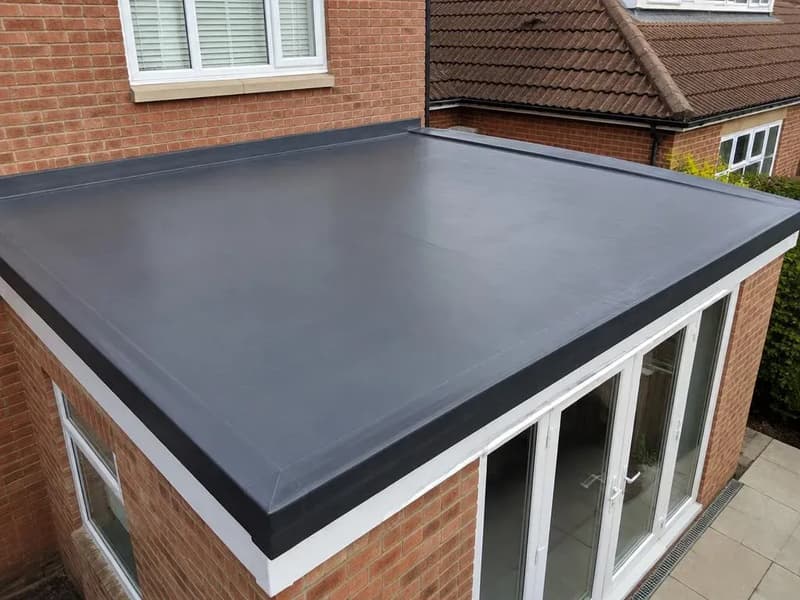
On a single-storey extension, the most common leak point is the joint where the flat roof meets the main house wall. The covering is turned up the wall and covered by a flashing, often lead, tucked into a mortar joint. If that flashing has lifted, the mortar has fallen out, or the upstand has been cut too short, water runs straight down behind it. The leak often shows up as a damp line along the top of the extension ceiling, right against the house.
Leaks can also start higher up. Water running down the wall from a cracked sill or a failing gutter above can get behind the flashing, so we check the wall as well as the roof.
Short-term steps, indoors only
Catch the water in a bucket and move anything valuable out of the room. Keep away from light fittings and sockets that are wet, and switch that circuit off if it's safe to. If the ceiling is sagging with water, keep everyone out of the room.
Please don't climb onto the flat roof yourself to look, especially when it's wet. Old decking can be weaker than it looks, and edges are easy to step off. Take photos from a window if you can, and give us a call.
Repair or replace in EPDM, GRP or felt
A small, isolated fault on a roof that is otherwise in good condition can often be repaired. A roof with several leaks, a wet or soft deck, or a covering that is worn out across its whole surface is better replaced. Patching a failing roof tends to move the leak along rather than stop it.
When we replace, we fit EPDM rubber, GRP fibreglass or felt systems, and we'll explain which suits your roof. Our flat roofs page compares them, and our guide on how long a flat roof lasts covers what wears them out. If the leak turns out to be on the pitched part of the house, see roof leaking? what to do next.
Domestic and commercial flat roofs
We work on flat roofs over kitchens, garages, dormers and porches, and on commercial buildings with larger flat areas. Call 07399 680142 (Mon to Fri 8am to 5:30pm, Sat 8am to 3pm) or send the details through our contact form. Jason will come and look, then send a free written quote.