
Signs a stack needs repointing
Mortar is meant to wear out before the bricks do. Over time, wind and rain scour it from the joints, and on a chimney, which sticks up above the roof and takes weather from every side, that happens faster than anywhere else on the house.
From the ground, look for joints that appear deep or hollow, gaps where mortar has fallen out completely, or plants growing from the stack. Grit in the gutters is another clue. Inside, a damp patch on the chimney breast, often worse after heavy rain, can mean water is getting in through the stack.
Height, position and access
Access is usually the biggest single factor in the cost. Repointing is careful work on all four faces of the stack, and it can't be done safely balanced on a ladder. Most jobs need scaffolding, and sometimes a working platform around the chimney itself.
A short stack on a bungalow is a very different proposition from a tall one on a three-storey house. Where the stack sits matters too: one on a gable end may be reached from the side, while one in the middle of a ridge needs access over the roof. A stack shared with a neighbour adds a conversation about who's paying for what.
How much mortar has failed, and the bricks
Some stacks only need a few courses near the top repointed, where the weather is worst. Others need every joint raked out and refilled. The more there is to do, the longer it takes.
The bricks themselves matter as well. If they're sound, repointing is straightforward. If faces have spalled or crumbled, some bricks may need cutting out and replacing, and if the brickwork is badly gone or the stack has started to lean, a partial or full rebuild may be the better option.
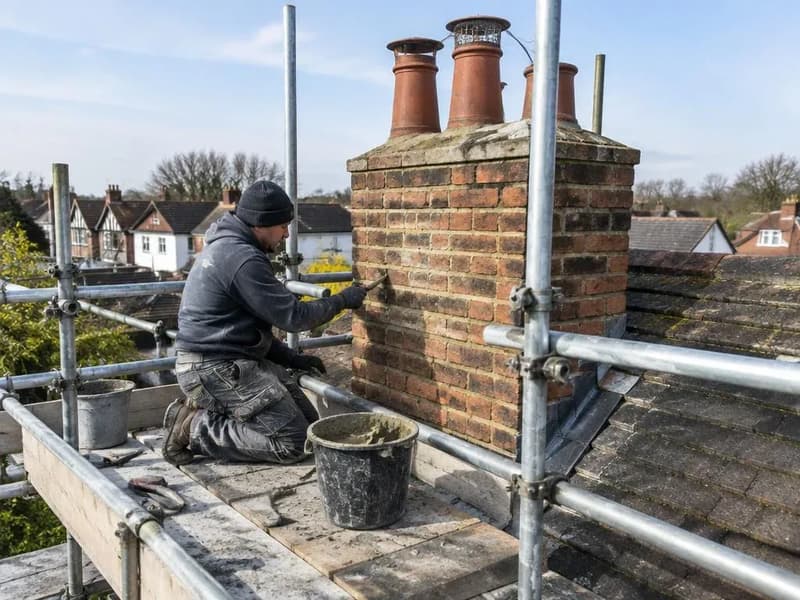
Flashing, lead and flaunching
Once access is in place, it's worth checking everything else on the stack. The lead flashing where the chimney meets the roof is a common source of leaks, and if it's lifted or split, replacing it now saves paying for access twice. Our lead roofing page explains that work.
On top, the flaunching is the sloped mortar bed that holds the pots and throws water off. When it cracks, rain gets straight into the stack. Loose pots can be reset, and unused flues can be capped. Each of these adds to the job, but they're usually far cheaper done together than separately.
Lime or cement mortar on older stacks
Many older chimneys were built with lime mortar, which is softer and more breathable than modern cement. As a general rule, repointing an old stack with hard cement can trap moisture and damage the bricks, so a lime-based mix is often better suited. Newer stacks built in cement can be repointed to match. The right choice depends on the age and construction of the chimney, and we'll talk it through with you.
Getting a free written quote
Because so much depends on the stack in front of us, we price chimney work after a visit. You'll get a free written quote setting out the repointing and anything else we recommend. Our chimney repair page covers the full range of stack work, and if water is already coming in, see roof leaking? what to do next.
Call 07399 680142 (weekdays 8am to 5:30pm, Saturdays 8am to 3pm) or use the contact form.